 Blog
Blog
Hack Squat Technique, Benefits and Common Mistakes
The hack squat is a staple of leg training because it allows lifters to challenge their quadriceps without balancing a barbell across their shoulders. A guided sled supports the movement, making it easier to concentrate on knee flexion, squat depth, and controlled repetitions under load.
That support doesn’t make proper technique automatic. Foot placement affects joint mechanics, machine design influences the available range of motion, and a poorly chosen setup can make an effective exercise uncomfortable. Loading the sled is simple. Getting consistent results requires more attention.
Whether you’re learning the movement or refining an established leg routine, understanding how the hack squat works can help you train your quadriceps effectively.
What Is a Hack Squat and How Does It Work?
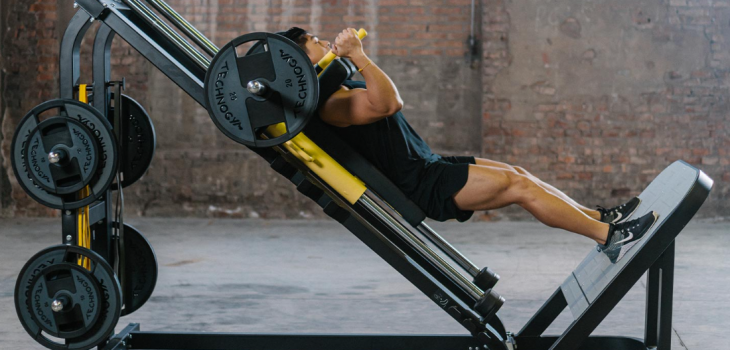
A hack squat is a lower-body resistance exercise typically performed on a machine with an angled track and guided sled. The lifter stands on a platform with their back against a padded support and shoulders beneath the machine’s pads. Bending the knees and hips lowers the sled, while extending both joints raises it.
Unlike a barbell squat, the machine guides the movement and reduces the need to balance an external load. Bracing and joint control still matter, but the lifter can devote more attention to producing force through the legs.
Most commercial gyms have plate-loaded hack squat machines with fixed foot platforms. Other designs use different track angles, shoulder-pad arrangements, or lever mechanisms. These differences influence resistance, available depth, and how comfortably the equipment accommodates different body proportions.
The supported position makes hack squats useful for demanding quadriceps workouts without the same balance and unsupported torso-stabilization requirements associated with barbell squats.
The exercise still places substantial mechanical loads on the knees and hips, particularly with heavy resistance or deep flexion. Appropriate loading and a comfortable setup help manage these demands.
Which Muscles Does the Hack Squat Target?
The quadriceps perform most of the work in a conventional hack squat. They contract eccentrically to control knee flexion during the descent and concentrically to extend the knees as the sled rises.
The main hack squat muscles worked include:
- Quadriceps: The vastus lateralis, vastus medialis, vastus intermedius, and rectus femoris produce knee-extension force.
- Gluteus maximus: Contributes to hip extension, particularly when rising from a deep squat.
- Adductor magnus: Its posterior fibers assist hip extension during the ascent.
- Hamstrings: Help stabilize the joints, although their contribution to hip extension is limited by their simultaneous action across the knee.
- Calves: The soleus and gastrocnemius contribute to ankle control.
- Trunk muscles: The abdominals and spinal stabilizers help maintain position against the back support.
Muscle involvement changes with squat depth, joint angles, stance, and machine geometry. Greater forward knee travel can increase the relative demand on the quadriceps, while deeper hip flexion may require more work from the glutes.
Because the hamstrings cross both the hip and knee, simultaneous extension of these joints limits their contribution compared with hip-hinge exercises.
Hack squats are therefore best treated as a knee-dominant movement rather than a replacement for dedicated hamstring training.
Step-by-Step Hack Squat Technique
Proper hack squat technique begins with stable foot pressure, comfortable joint movement, and a repeatable range of motion. Good hack squat form depends on controlling the sled rather than simply moving the greatest possible weight.
Machine Setup and Starting Position
Begin with a light load, particularly on unfamiliar equipment. The sled itself may provide considerable resistance, and identical plate loads can feel different across machines.
- Stand on the platform with your feet approximately shoulder-width apart.
- Position your shoulders beneath the pads and keep your back against the support.
- Place your feet where your heels remain planted and your knees can travel comfortably in the direction of your toes.
- Grip the handles, brace your abdomen, and extend your legs enough to release the safety mechanism.
- Check that you can lower the sled without excessive pelvic movement or losing stable contact with the platform.
Perform several light repetitions before adding significant weight.
If the shoulder pads force an uncomfortable position or the platform restricts your stance, adjust the equipment where possible. Some machines simply won’t suit every lifter’s proportions.
Squat Depth and Movement Control
Start the descent by bending your knees and hips together. Let your knees move forward naturally while keeping your heels planted.
Lower the sled at a controlled pace. Avoid dropping into the bottom position or shifting your weight entirely onto your toes. Maintain pressure across the heel, midfoot, and forefoot.
Hack squat depth depends on ankle mobility, body proportions, machine design, and resistance. There’s no advantage to forcing the sled lower once you can no longer maintain a stable position.
Aim for the deepest controlled position you can reach without your pelvis lifting excessively from the pad, your heels rising, or your joints becoming uncomfortable.
To return to the starting position, push against the platform and extend your knees and hips together. Reverse direction smoothly rather than bouncing out of the bottom.
Finish without snapping your knees into extension, then begin the next repetition once your position is stable.
How Foot Placement Changes Muscle Emphasis
Hack squat foot placement affects the relative demands on the knees, hips, and ankles.
On many machines, placing the feet lower encourages greater forward knee travel and can increase the relative demand on the quadriceps. A higher position may allow more hip involvement while reducing the ankle dorsiflexion required.
The exact effect depends on platform angle, sled orientation, stance width, and individual mechanics.
Common hack squat stance adjustments
| Foot position | Potential effect |
| Mid-platform, shoulder-width | Balanced starting position for many lifters |
| Higher on the platform | May increase hip contribution and reduce ankle dorsiflexion demands |
| Lower on the platform | May increase forward knee travel and knee-extension demand |
| Wider stance | Changes hip positioning and may alter adductor involvement |
| Narrower stance | Changes joint angles without isolating a particular quadriceps head |
A narrow stance doesn’t automatically isolate the outer quadriceps. Similarly, turning the toes outward doesn’t guarantee greater activation of the inner quadriceps.
Start with a comfortable stance that allows consistent depth and knee tracking. Small adjustments generally work better than extreme foot positions.
Hack Squat Benefits
The main hack squat benefits come from its guided movement, substantial quadriceps involvement, and straightforward loading options.
Quadriceps hypertrophy. Hack squats allow the quadriceps to work through a substantial range of motion under resistance. Combined with sufficient effort and progressive overload, they contribute to muscle growth.
Reduced balance demands. The guided sled removes much of the balance challenge associated with free-weight squats, particularly during demanding sets.
Additional torso support. The back pad reduces the need to stabilize an unsupported barbell. However, substantial forces still act on the legs, pelvis, and trunk, so the exercise isn’t free of spinal loading.
Straightforward progression. Plate-loaded machines make resistance adjustments simple. Progress can also come from completing more controlled repetitions at an established depth.
Training variety. Hack squats provide a different loading pattern from lunges, barbell squats, and leg presses, making them a useful addition to quadriceps training.
For lifters whose barbell squats are limited by balance or torso fatigue, the hack squat offers another way to challenge the legs. Its value comes from how effectively it fits the training program, not from being inherently superior to free-weight exercises.
Hack Squat vs Traditional Barbell Squat
The hack squat vs squat comparison comes down largely to external support, balance requirements, and the specificity of the movement.
During a barbell back squat, the lifter controls the bar’s path while keeping the combined center of mass over the base of support. The legs, trunk, and upper body work together to maintain positioning.
A hack squat constrains the movement path and supports the torso, allowing greater attention to the knee extensors.
| Feature | Hack squat | Barbell back squat |
| Load path | Guided by the machine | Controlled by the lifter |
| Balance requirement | Relatively low | Higher |
| Quadriceps involvement | High | High |
| Trunk stabilization | Supported, but still active | Substantial unsupported stabilization |
| Technique demands | Machine setup and joint control | Whole-body coordination and bar control |
| Load comparison | Depends on machine design | Based on barbell and plate weight |
| Main application | Lower-body strength and hypertrophy | General strength, squat-specific performance, and hypertrophy |
Barbell squats are essential for lifters who need to improve performance in that specific movement, particularly competitive powerlifters.
For general quadriceps development, either exercise can be effective. Individual mechanics, equipment availability, and consistent progression often determine which fits better.
Machine loading also complicates comparisons. Sled angle, friction, and machine weight affect resistance, so a 300-pound hack squat isn’t equivalent to a 300-pound barbell squat.
Hack Squat vs Leg Press
The hack squat vs leg press comparison is relevant because both exercises allow heavy lower-body training with substantial external support.
In a hack squat, the lifter stands against a back support and moves along a guided path. In a conventional 45-degree leg press, the lifter sits or reclines while pushing a weighted sled away from the body.
Hack squats often allow substantial forward knee travel and deep knee flexion. On a leg press, the available range depends on seat angle, platform placement, and how far the sled travels before the pelvis begins moving away from the backrest.
The leg press may feel more comfortable for lifters who find the shoulder pads or standing position of a hack squat restrictive.
Both exercises can build substantial quadriceps muscle. The more useful choice allows challenging sets, consistent movement, and progressive loading without unnecessary discomfort.
Including both can make sense when they provide distinct training demands rather than simply duplicating the same work.
Training Goals and Programming
A hack squat workout should reflect the lifter’s experience, training priorities, and other lower-body exercises performed during the week.
Hack squats can serve as a primary quadriceps movement or an accessory in a broader leg strength training program. Loading and repetition ranges should match the intended outcome.
Building Quadriceps Strength
For general leg strength, moderately heavy sets allow lifters to develop force while maintaining reliable technique. Very low-repetition sets are possible, but most people don’t need maximal loading to improve their lower-body strength.
Muscle growth occurs across a broad repetition range. Sets of 6–15 are convenient for hack squats, although higher repetitions can also be effective when performed sufficiently close to muscular failure.
For quad-focused training, choose a setup and load that challenge the quadriceps without allowing discomfort or loss of control to end the set prematurely.
Balanced lower-body development also requires exercises targeting the hamstrings through hip extension or knee flexion. Romanian deadlifts and leg curls complement the knee-dominant demands of hack squats.
Different hack squat variations, including angled-sled and lever-based machines, may change the resistance profile. Treat each machine as a separate exercise when tracking loads and progress.
Sets, Repetitions and Progressive Overload
The following ranges provide practical starting points rather than fixed prescriptions.
| Training goal | Working sets | Repetitions | Typical effort |
| General strength | 3–5 | 4–8 | About 1–3 reps in reserve |
| Muscle growth | 3–4 | 6–15 | About 1–3 reps in reserve |
| Higher-repetition accessory work | 2–4 | 12–20 | About 1–3 reps in reserve |
| Technique practice | 2–3 | 8–12 | Light to moderate, well short of failure |
These are per-session guidelines. Beginners may need fewer sets, particularly when hack squats accompany other compound leg exercises.
Progressive overload involves increasing training demands as strength and work capacity improve. On a hack squat machine, this usually means adding weight or completing more repetitions while preserving technique.
For example, start with three sets of 8–12 repetitions. Once all three sets reach 12 controlled repetitions at the intended effort, increase the load slightly and work toward the upper end again.
Adding weight shouldn’t require sacrificing depth or control. Heavy sets often benefit from two to three minutes of rest or more, while lighter accessory work may require less recovery.
Common Technique Mistakes and How to Avoid Them
Most hack squat mistakes involve excessive loading, inconsistent movement, or a setup that doesn’t suit the lifter’s proportions.
1. Using More Weight Than You Can Control
Excessive loading often leads to shortened repetitions and rushed descents. The sled may still move, but reducing the range changes the training stimulus and limits work at deeper knee angles.
Lower the resistance until every repetition reaches a consistent depth under control.
2. Lifting the Heels
Heels rising from the platform may indicate insufficient ankle dorsiflexion for the chosen foot position. Excessive depth or poor control can contribute as well.
Try moving your feet slightly higher, adjusting stance width, or reducing depth. Maintain stable pressure across the whole foot.
3. Forcing Excessive Squat Depth
Deep knee flexion can be productive, but forcing extra depth after losing control creates unnecessary problems.
If your pelvis lifts away from the pad, your heels rise, or the bottom position causes discomfort, shorten the range and reassess your setup.
4. Letting the Knees Collapse Inward
Your knees should generally travel in a direction consistent with your toes. Small variations are normal, but repeated, uncontrolled inward collapse under heavy resistance is worth correcting.
Reduce the load if needed and adjust your stance until you can maintain comfortable knee tracking.
5. Bouncing at the Bottom
Dropping rapidly into the deepest position and rebounding makes the movement difficult to control, particularly with heavy loads.
Slow the descent and reverse direction deliberately. A brief pause near the bottom can help establish control.
6. Losing Contact With the Back Support
Excessive pelvic movement or arching away from the pad changes the exercise mechanics and may cause discomfort.
Keep your torso stable against the support without forcing your lower back unnaturally flat. Adjust the range if your position deteriorates.
7. Locking the Knees Aggressively
Fully straightening the knees isn’t inherently dangerous. The concern is snapping into terminal extension or allowing passive joint structures to support the load between repetitions.
Complete the upward movement smoothly and maintain control before lowering the sled again.
8. Ignoring the Machine’s Safety Mechanisms
Hack squat machines use different catches, handles, and safety stops. Some require rotating the handles, while others have separate locking systems.
Check how the mechanism operates before loading the machine. Set adjustable safety stops appropriately and know how to secure the sled if you cannot finish a repetition.
9. Copying Someone Else’s Stance
A foot position that works for one lifter may be uncomfortable for another. Femur length, ankle mobility, and machine construction all affect the movement.
Use standard technique principles as a starting point, then make modest adjustments based on your mechanics.
Persistent joint discomfort shouldn’t be ignored. If modifying the load, stance, or range doesn’t resolve the problem, seek an assessment from a qualified healthcare professional.
FAQ
Are hack squats better than regular squats for building quads?
Both exercises can develop the quadriceps with sufficient resistance, effort, and training volume. Hack squats offer greater external stability, while barbell squats require more balance and whole-body coordination. The better option depends on your goals and which movement you can perform consistently.
How deep should you go on a hack squat?
Lower the sled as far as you can while keeping your feet planted, your back supported, and the movement controlled. Appropriate depth depends on mobility, body proportions, machine design, and load. Forcing additional depth after losing stability isn’t necessary.
Can hack squats replace barbell squats?
Hack squats can replace barbell squats in programs focused on general lower-body strength or hypertrophy, provided other exercises cover the remaining movement patterns. They aren’t a complete substitute when the goal is to improve barbell squat technique or competition performance.
Where should your feet be on the hack squat machine?
Start with your feet around shoulder-width apart near the middle of the platform. Adjust their position until your heels remain stable and your knees track comfortably. Higher and lower placements change joint demands, but the ideal position varies between lifters and machines.
Are hack squats bad for your knees?
Hack squats aren’t inherently harmful to healthy knees, although they can place substantial mechanical loads on the joint, particularly at deeper flexion angles. Appropriate resistance, gradual progression, and controlled movement help manage these demands. Existing knee symptoms may require individual modifications.
How often should you do hack squats?
Many lifters can perform hack squats once or twice per week, depending on total leg-training volume and recovery. They can serve as the main quadriceps exercise or complement other lower-body movements. Higher frequencies are possible when volume and intensity are managed appropriately.