 Blog
Blog
Bench Press: Proper Technique, Muscles Worked and Training Tips
The bench press looks straightforward: lie on a bench, lower the bar to your chest, and press it back up. Yet two people lifting the same weight can get very different results. One makes steady progress, while the other struggles with shoulder discomfort, inconsistent repetitions, or a plateau that won’t budge.
Often, the difference comes down to technique. Grip width changes the demands on your shoulders and elbows. Foot placement affects stability, while the bar’s path influences how efficiently you move the weight. These details become increasingly important as the load gets heavier.
Whether you’re learning the exercise or refining an established bench press workout, understanding how the movement works can make training more productive. Here’s what matters, from muscle involvement and proper form to programming and long-term strength development.
Why the Bench Press Is a Fundamental Strength Exercise
The bench press is a staple of powerlifting, bodybuilding, and general resistance training, though each discipline uses it differently.
Powerlifters aim to lift the heaviest weight possible under competition rules. Bodybuilders typically use it to develop their chest, shoulders, and triceps. Recreational lifters can improve upper-body strength while building muscle, particularly when pressing is combined with pulling exercises.
Progress is easy to measure. You can track the weight lifted, repetitions completed, or total weekly workload. An extra repetition or a small weight increase might seem insignificant, but those improvements accumulate over months of consistent training.
The barbell isn’t essential for everyone. Dumbbells, machines, and push-ups can also develop pressing strength. What makes the barbell bench press particularly useful is its repeatability and the ability to increase resistance in small increments.
Muscles Worked During the Bench Press
Three muscle groups produce most of the pressing force, supported by several stabilizers.
| Muscle | Role during the lift |
| Pectoralis major | Produces horizontal shoulder adduction and contributes much of the pressing force |
| Triceps brachii | Extends the elbows as the bar rises |
| Anterior deltoids | Assist horizontal shoulder adduction and help move the arms upward |
| Rotator cuff | Stabilizes the shoulder joint |
| Serratus anterior | Contributes to shoulder-girdle stability and scapular control |
| Upper-back muscles | Help maintain a stable position against the bench |
The pectoralis major is the primary target of a conventional flat bench press. Both its clavicular and sternocostal regions contribute, although their relative involvement changes with the pressing angle and arm position.
The triceps handle elbow extension, becoming particularly important as the arms straighten. Meanwhile, the anterior deltoids assist shoulder movement throughout the press.
Grip width changes how these muscles share the workload. A wider grip generally shortens the bar’s travel distance and alters shoulder mechanics. A narrower grip increases elbow-extension demands and can place greater emphasis on the triceps.
The exact distribution depends on individual proportions, technique, and range of motion. No grip completely isolates one muscle.
Stabilizing Muscles
Heavy pressing requires coordinated effort beyond the chest and arms.
The rotator cuff helps control the humeral head within the shoulder joint. The trapezius, rhomboids, and latissimus dorsi contribute to upper-back stability, while the abdominals and spinal extensors help maintain torso rigidity.
Your legs also matter. Pressing your feet into the floor creates lower-body tension, commonly called leg drive. Rather than lifting your hips, the aim is to reinforce your position on the bench.
Although the serratus anterior contributes to shoulder-girdle function, the shoulder blades remain relatively stable against the bench during conventional barbell pressing. Their movement is more restricted than during exercises such as push-ups.
How to Perform a Bench Press Correctly
Reliable bench press technique begins before the first repetition. A consistent setup helps you control the bar, reproduce the same movement, and gradually handle heavier loads.
Bench Setup and Grip Width
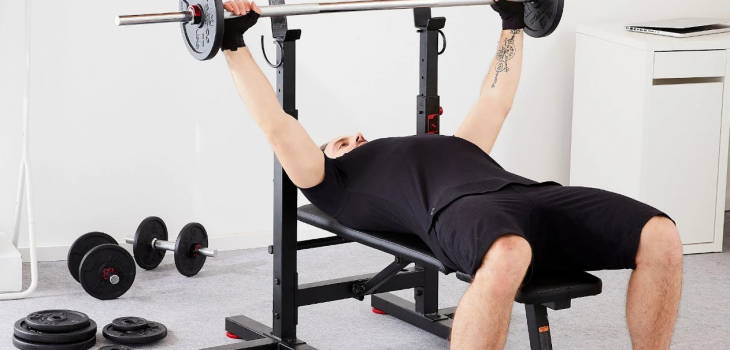
Lie on the bench with the bar approximately above your eyes. Adjust your position so you can unrack it without reaching excessively backward.
Plant your feet firmly on the floor. Depending on your proportions, they may sit beneath your knees or slightly farther forward or back. Choose a position that provides steady pressure without compromising balance.
Draw your shoulder blades back and slightly downward, creating a firm upper-back position. A natural lower-back arch is acceptable as long as your glutes remain on the bench.
For a standard bench press grip, begin with your hands somewhat wider than shoulder width. When the bar reaches your chest, your forearms should be approximately vertical when viewed from the front.
Treat this as a starting reference, not a rigid requirement. Extremely wide grips aren’t necessary for chest development, while an excessively narrow position may feel awkward.
Wrap your thumbs around the bar and position it securely across your palms, near the base of your thumbs. Keep your wrists reasonably aligned above your forearms rather than allowing the bar to roll toward your fingers.
Before unracking, check that your hands are evenly spaced and the bar is centered.
Lowering and Pressing the Bar
Take a breath, brace your torso, and lift the bar out of the rack with your arms extended. For heavy sets, a spotter can assist with the handoff.
Position the bar above your shoulders before beginning the descent.
During the lowering phase:
- Bend your elbows while maintaining upper-back tension.
- Lower the bar under control toward your mid-to-lower chest.
- Allow your elbows to follow a comfortable path rather than forcing them outward or tightly against your ribs.
- Keep your forearms reasonably aligned beneath the bar.
- Make light contact with your chest without bouncing the weight.
The exact touch point depends on arm length, grip width, torso proportions, and pressing style. A repeatable bar path matters more than copying another lifter’s technique.
From the bottom position, press firmly while maintaining foot pressure. The bar typically travels slightly backward toward your shoulders as it rises, following a curved rather than perfectly vertical path.
Extend your elbows to complete the repetition without aggressively pushing your shoulders forward.
A controlled descent followed by a forceful, well-coordinated press is generally more productive for strength development than deliberately moving slowly through both phases.
Bench Press Variations and Their Purposes
Changing the bench angle, equipment, or grip alters the exercise’s demands. Different bench press variations can emphasize particular muscles, accommodate individual joint mechanics, or provide additional training stimulus.
Flat vs Incline Bench Press
The flat bench press develops horizontal pressing strength through substantial involvement of the chest, triceps, and anterior deltoids.
An incline bench press places the torso at an upward angle. A moderate incline, commonly around 15–30 degrees, tends to increase the relative contribution of the clavicular, or upper, portion of the pectoralis major.
As the angle increases, the anterior deltoids generally take on more work. At steep inclines, the movement begins to resemble a shoulder press.
| Feature | Flat bench press | Incline bench press |
| Primary emphasis | Overall chest development | Greater upper-chest emphasis |
| Shoulder involvement | Substantial | Generally increases with incline |
| Typical working weight | Usually heavier | Usually lighter |
| Main application | General pressing strength | Upper-chest training and pressing variety |
Neither version is universally superior. Including both may be useful for balanced chest development, provided the additional workload doesn’t interfere with recovery.
Barbell vs Dumbbell Bench Press
The barbell bench press connects both hands to a single load. This makes resistance easier to standardize, allows small weight increments, and suits maximal strength training.
Dumbbells let each arm move independently. You can adjust wrist and elbow positions more freely, which some lifters find more comfortable. They may also reveal differences in strength or coordination between sides.
Dumbbells can permit a greater range of motion, but lowering them excessively far below chest level may increase shoulder stress.
The choice becomes clearer when you consider the practical differences:
- Barbell: Easier to load progressively and better suited to testing maximal bench press strength.
- Dumbbells: Allow independent arm movement and greater freedom in the pressing path.
- Barbell: Requires careful rack positioning and appropriate spotting during heavy sets.
- Dumbbells: Become harder to bring into the starting position as the weights increase.
Both can build muscle effectively. Choose according to your training goals, available equipment, and which movement you can perform comfortably.
Common Bench Press Mistakes
Most bench press mistakes appear when the load exceeds what a lifter can control or when positioning changes between repetitions.
Excessive elbow flare is a frequent example. Letting the upper arms move too far outward, particularly with a very wide grip, can make the shoulders uncomfortable. Tucking the elbows tightly against the torso isn’t necessarily better. Aim for a controlled path with the forearms supporting the bar.
Lifting the hips to finish a difficult repetition is another problem. It changes your body position and makes progress harder to measure. If this happens repeatedly, reduce the weight.
Bouncing the bar off your chest can compromise control and introduce unnecessary impact. A deliberate touch is sufficient for most strength training.
Other mistakes include:
- Excessively bent wrists: Holding the bar too close to the fingers increases wrist-extension demands.
- Losing upper-back tension: A shifting shoulder position makes the pressing base less stable.
- Uneven bar movement: One side rising faster may indicate fatigue, inconsistent positioning, or differences in strength and coordination.
- Unintentionally shortened repetitions: Cutting the movement short makes performance harder to compare.
- Poor rack positioning: Hooks set too high or too far behind the shoulders can disrupt the unrack.
Correct the problem that most affects your lift rather than changing everything simultaneously. Recording a set from the side or a front-quarter angle can reveal issues that aren’t obvious while pressing.
Building Strength Through Progressive Overload
Bench press strength develops when training demands gradually increase and recovery keeps pace. This principle, known as progressive overload, doesn’t require adding weight every session.
You can progress by completing more repetitions at the same weight, increasing resistance, or improving the consistency of your working sets.
Suppose you’re bench pressing 60 kg for three sets of six repetitions. Instead of immediately adding weight, work toward three sets of eight.
Once you complete all three sets with consistent technique and your planned repetitions in reserve, increase the load slightly and return to the lower end of the range. This method is called double progression.
Example of double progression
| Session | Weight | Sets × reps |
| 1 | 60 kg | 3 × 6 |
| 2 | 60 kg | 3 × 7 |
| 3 | 60 kg | 3 × 8 |
| 4 | 62.5 kg | 3 × 6 |
This sequence is illustrative, not a required weekly schedule. Reaching the next target may take several sessions.
For maximal strength, heavier sets of roughly 3–6 repetitions are common. Sets of 6–12 provide a practical combination of strength and hypertrophy training, although muscle growth can occur across a much broader repetition range when effort is sufficient.
Rest periods influence performance. Heavy compound sets often benefit from two to five minutes between efforts, while lighter work may require less.
If your pressing numbers decline across several sessions, adding more sets probably isn’t the answer. Review recovery, training intensity, and weekly workload before increasing volume.
How to Include Bench Press in a Training Program
The bench press fits into full-body programs, upper/lower splits, and push-focused routines. Its placement depends on how important pressing strength is to your goals.
If improving your barbell bench press is the priority, perform it early in the session after warming up. Heavy pressing demands coordination, which becomes harder to maintain as fatigue accumulates.
For many beginners, bench pressing twice weekly provides sufficient practice and training stimulus. Experienced lifters may benefit from two or three sessions, depending on total workload and recovery.
Here’s a simple example of how to organize pressing and complementary upper-body exercises.
| Session | Exercise | Sets × reps |
| Day 1 | Barbell bench press | 3 × 5–6 |
| Day 1 | Chest-supported row | 3 × 8–10 |
| Day 1 | Triceps exercise | 2 × 10–12 |
| Day 2 | Dumbbell bench press | 3 × 8–10 |
| Day 2 | Lat pulldown | 3 × 8–12 |
| Day 2 | Lateral raise | 2 × 12–15 |
This example focuses on upper-body training rather than providing a complete program. Lower-body exercises and other major movement patterns should be included elsewhere.
Rows develop horizontal pulling strength, while pulldowns train vertical pulling. Both complement a program built around pressing movements.
Remember that shoulder presses, dips, push-ups, and chest press machines also contribute to upper-body fatigue. Account for them when planning weekly training volume.
Begin with a manageable workload. If performance improves and recovery remains good, additional sets may be useful. If pressing strength stagnates while fatigue accumulates, reducing volume temporarily may be more productive.
Safety Tips and Injury Prevention
Bench press safety becomes particularly important when handling heavy loads or training close to muscular failure.
Use a competent spotter for challenging barbell sets. They should know when assistance is needed and avoid touching the bar during repetitions you can complete independently.
When training alone, use a power rack with properly positioned safety bars. Avoid testing maximal weights on a standard bench without suitable protection.
Warm up progressively rather than jumping directly to your working weight. Begin with lighter loads and increase resistance in stages.
For example, before working at 80 kg, you might start with the empty bar and perform additional warm-up sets at gradually increasing weights. Adjust the increments to your strength level.
Pay attention to your shoulders, elbows, and wrists. Muscle effort and ordinary fatigue are expected, but sharp pain, instability, or persistent joint discomfort shouldn’t be ignored.
Changing grip width, modifying the range of motion, or switching equipment may help some lifters train more comfortably. Persistent symptoms warrant assessment by a qualified healthcare professional.
Finally, don’t assume an elite powerlifter’s setup is appropriate for everyone. Your grip, arch, and pressing path should suit your proportions and allow controlled movement.
FAQ
How much should a beginner bench press?
There’s no universal starting weight. Begin with an empty barbell or a lighter training bar if necessary, then choose a load you can handle for controlled repetitions. Learning consistent bench press form matters more than the weight used during your first sessions.
Is bench press enough to build a bigger chest?
The bench press can provide a substantial stimulus for chest growth when performed with sufficient effort and volume. Incline pressing, dumbbell exercises, and chest fly variations can add useful variety. Total workload, nutrition, and recovery also influence muscle development.
Should the bar touch your chest during bench press?
In a conventional full-range barbell bench press, the bar generally makes light contact with your chest without bouncing. Some lifters may need to modify their range of motion because of discomfort or mobility limitations. In powerlifting competitions, the bar must remain motionless on the chest until the referee gives the press command, subject to federation rules.
How often should I bench press to get stronger?
Twice weekly is a practical starting point for many lifters. Some progress with one session, while others benefit from three or more. The best frequency depends on how much quality work you can complete and recover from consistently.
Why is my bench press not improving?
A plateau may result from inconsistent technique, insufficient training stimulus, inadequate recovery, or repeatedly attempting weights beyond your current ability. Review your training log for changes in repetitions, working weights, and performance across sets. Smaller weight increases, a more consistent setup, or better fatigue management may help restore progress.